

After fifteen years of trading and a huge number of very exciting projects, yellowcog is closing down. It's been quite a ride, and we wanted to let everyone know we've had a great time but it's time to move on.
Over those years, yellowcog's products became standard — and in some cases compulsory — kit in various sporting formulae and series. Our devices weren't always on show, but they were often working quietly behind the scenes, doing exactly what they were designed to do, year after year. If you've watched motorsport, followed endurance events, or tuned in to certain TV shows over the last decade and a half, there's a decent chance our kit was somewhere in the mix without you ever knowing.
We designed and built our own hardware from scratch and sold it all over the world, regularly packing up and flying out to work with some of the most iconic marques and teams on the planet. Our kit has clocked up incalculable miles in the process — from the Kenyan desert to the waters of Bermuda, from circuit paddocks to open ocean, from university labs to the pit lane.
We worked on multiple Guinness World Records™ and appeared more times than we can remember on live TV, recorded TV, international adverts and iconic shows. We've monitored athletes, racing drivers and record-breakers of all kinds, and we've known drivers from their very first rookie season all the way through to champion status.
We've been sprayed with champagne in the pit lane and memorably toasted in one particular bar for what we'd pulled off that day. We've stayed everywhere from elite training camps to car parks — sometimes on the same trip. We've been given unrestricted, backstage access at major sporting events as though we were VIPs. We cobbled together Autosport show stands from our own furniture and pushed our way through more than one tricky installation. Many years ago, we even had our products banned — it turns out they had copied and deployed something very much like our design. Such an honour!
From the original Pilot-MUX, which had its baptism of fire at the Le Mans 24 Hours, all the way through to the Pilot-CAN in IndyCar today and everything in between, it's been absolutely amazing to be part of. We've worked with brilliant people, tackled genuinely interesting problems, and had far more fun than any of us probably deserved.
Thank you sincerely to every friend, partner, customer and collaborator who was part of the journey over the years. It meant a great deal, and we hope working with us was at least half as enjoyable for you as it was for us.
Now, if you'll excuse me — I'm off to build a folly.

ANT+ is entering old age - but not retirement.
Garmin are to end the development of ANT+, or more specifically, ANT+ "Profiles". For those confused with Garmin's terminology - a "profile" sets out how the data should be packaged and interpreted between two ANT+ devices. Common profiles include heart rate straps, muscle oxygenation sensors and bike power meters.
We should maybe mention here what the difference between "ANT" and "ANT+" is. The "+", to the user, says two things: first, this device confirms to the specified ANT+ profile and, second, the device has been fully tested and approved by Garmin's test suite to guarantee conformity to the stated profile. This meant you could go out and buy a couple of ANT+ devices and be sure they would work together if they had the same ANT+ profile logo. So, what is ANT? ANT is the radio communications standard (from radio frequencies and timings up to when to listen, send and reply) that the profile data is transmitted over. In simple terms: ANT is concerned with moving data bytes; ANT+ with information.
This is not a hugely shocking "announcement" since for many years (ten!?) it is clear that it has been taking a backseat to BLE. "BLE is now the standard in everything" is basically true (for phones, yes) but does not necessarily mean another technology doesn't have its place. ANT+ has its place in lots of equipment in systems where looking at your phone might not really be of much use - yes, imagine!
The demise of ANT+ is by mostly being put down to the EU's insistence on encryption of personal data. The perception from developers' (or technical users') point of view could be characterised as "BLE has encryption baked into it whereas ANT+ added too little too late". This is how it feels anyway! It is unfair as ANT+ as a standard can and sometimes does support encrypted data. Its problem was that it was so (enjoyable and) easy to use without encryption that manufacturers didn't support it.
It should be pointed out that yellowcog has never sold ANT+ products (I must repeat this often as Garmin like to keep tabs on us since we are a licensed producer of ANT - but not ANT+ - devices). The reason we don't do ANT+ is firstly the cost, you have to pay Garmin for the privilege, but also we support so many profiles and custom "profiles" that it would slow us down. We interface and adapt to bespoke situations and systems all the time and it is not going to help anyone for us to seal our device software just to put a little ANT+ logo on the box.
Garmin are continuing to support the development of ANT(+) silicon/processors. It is the profiles that are now frozen. Arguably, this is where it's interesting for us all: if we want to do something new and unique then we'll have to work on it together - now that's where the fun begins!

We have flipped our website on its head so that it is now easier to find answers according to what you want to achieve rather than by use cases and individual products. Our products are now used in more areas and industries so this should help people in different arenas get to the required information and solutions. The site is arranged to mirror the way our Embedded Setup software allows you to configure your devices – although even though the website we now lists more of the options, it is still not exhaustive. It is a balance between being able to find exactly what you need and swamping the site with everything bit of hardware we have made. We have also listed some third-party kit we have used, that might be of interest, along with direct links to the manufacturers’ website. As you browse around, if you do not find exactly what you are looking for, you’ll find enough to want to get in touch. We are always happy to advise on options – no purchase necessary!
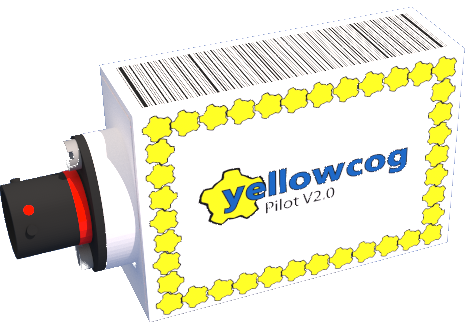
The Pilot-MUX is being discontinued due to core components reaching end-of-life. As anyone who has tried to buy components or electronics over the last few years will know, manufacturing lead-times have ballooned, and some items just never resurface. There are many reasons for these supply issues, but it all comes down to the silicon fabrication houses having focused on their core components at the expense of the more niche parts that companies like yellowcog rely on.
Will there be a replacement? This is going to be customer driven. There are certainly many who use the Pilot-MUX that could now move to using the Pilot-CAN and its siblings. For anyone who may still need the MUX specific features then just get in touch and we’ll see what we can do.
The first ever version was released about a decade ago and was named as the Pilot-Cosworth. It was very much a prototype having far more on-board than was needed but still limited to only RS-232 output. It was designed for the Le Mans 24 hour and its success at the race left yellowcog with a new and interesting product that had now been tested in very demanding circumstances.
From the original prototype the first true Pilot-MUX was released in 2014. The fundamental design allowed for collecting wireless data, such as heart and breathing rates and waveforms such as ECG, and outputting these over serial or CAN bus. At the start, each device was configured in-house and then shipped with a fixed role.
It was the Pilot-MUX that drove the development of the Windows configuration software that allows a near-infinite number of ways to configure our devices. This Pilot-MUX configurability led to custom variant boards which in turn led to today’s flagship product, the Pilot-CAN.
So, what of Bluetooth classic connectivity? There are a few products we still use that are better when using Bluetooth classic, primarily the very popular Zephyr BioHarness. But they are becoming fewer and increasingly obsolete items which, if still valid in the domain, are themselves being updated to Bluetooth LE.

October 2020 marks ten years of yellowcog. We have done a lot of interesting projects, designed stacks of embedded hardware, created some cool algorithms, plenty of Windows software and also the odd app. We have expanded our hardware to share data between CAN, ANT, BLE, Bluetooth, WiFi, GPRS and wired our kit to many different systems. We’ve sold to many different companies, sports and helped universities research not only physiology but wireless communications as well.
But what we’ve done so much more… We’ve worked on four world records including official Guinness World Records™ records. We’ve been invited to islands, beaches, cities, racing tracks, golf courses, crumbling warehouses, F1 teams' headquarters and the world's best universities. We’ve appeared on live TV, recorded TV, international adverts and provided live data to OB trucks and film studios. We’ve hung about in luxury trailers, on racing yachts, been filmed for hours, been in magazines, met famous people, been watched by tens-of-millions of people on the internet. Our equipment has been used in North America, South America, Europe, Middle East, Africa, Asia and Australia (we will give a generous discount to anyone who brings us a project in Antarctica). We’ve monitored people on a range of drugs including ecstasy, amphetamines and LSD (all taken legally for science!). We’ve stood in a field throwing hardware, driven around the English countryside wearing crash helmets, made people jump up-and-down on high-speed cameras, punished past colleagues by making them run for as long as they can – just to collect data. We have employed more women than men to help us with our projects. We’ve worked with drivers from their rooky season to first wins. Conducted medical research at the local pub. We’ve been driven round race tracks by top drivers. We’ve been and exhibited at trade shows. We’ve jumped in and out of IndyCars, rally cars, track cars, Lamborghinis, Lotuses, Audis and simulators. We’ve also paid tax on all our income and not avoided any or used any “schemes” to reduce corporation tax.